Showing posts with label economy. Show all posts

Friday, May 29, 2020

Vancouver Blossoming into Big City

Vancouver is transitioning well into "city" territory rather than it's traditional role of suburb. Not since WWII has Vancouver really been this far ahead of all the other regional cities in the Portland-Vancouver Metro Area.

The census 2020 should show the City proper at close to 200,000 people and in the 14 zip-codes that make up the whole of the 'Couv' the count should roll in around 335,000. Just completing the pending Orchards annexation alone will put Vancouver well into the top 100 cities in America ahead of Buffalo NY and they have an NFL team!

Vancouver is living up to the challenge with a robust commitment to urban development from high density projects in suburbia right to the core of the city with the new waterfront and increased density in the downtown area. Our skyline is transforming before our eyes with a sweeping panorama from the Interstate bridge to the midway point of the waterfront. But the waterfront has just begun to grow and over the next several years our urban skyline will feature a contiguous row of high rise buildings from downtown all the way to the port.

Real estate opportunities abound for commercial, residential and even industrial applications. This town is tearing away from the tether to Portland and although our symbiotic relationship will not likely ever go away, we are out of the nest and starting to soar.

Business opportunities continue to provide excellent jobs and the desire for employees to avoid commuting to Portland ensures Washington employers the best pick of local talent. Living and working in Clark County is the dream scenario as employees avoid Oregon's brutal, soul crushing income tax, lousy highway system, and Portland's aggressive homeless population. Meanwhile employees over here enjoy superior schools, less busy highways, and overall better quality of life.

Vancouver has an opportunity when this COVID crisis is over to make serious plays for employers in Portland fed up with the excessive regulation, constant protests disrupting business, homeless camps destroying the environment with litter and human waste, and unhappy employees eager to leave for greener pastures elsewhere... like Vancouver.

Hopefully the Mayor is up to the challenge and we can continue this amazing urban transformation. For residential real estate the options in Vancouver are across the full spectrum from 10,000 square foot mansions on the water to multi-million dollar riverfront condos and everything else right down to a bargain value on one of those darling 'Kaiser Cottages' one can still find under $300,000.

Things are still looking up in America's Vancouver and all across Clark County.

Friday, August 16, 2019

Inverted Yield Curve Aids in Market Panic

Earlier this week the Stock Market shed some 2-3% of its value on one trading day. The DJIA dropped 800 points on Wednesday after the markets showed an inverted yield curve with short term interest rates higher than long term rates. This is sometimes a precursor to a recession and that has investors spooked.

Now the reality is that inverted yield curves do often appear before an economic slowdown, but it is by no means a definitive harbinger. In fact there are many reasons that investors might pour assets into long term bonds and some of that action may of actually been from turbulence in Hong Kong. The US economy is not quite as robust as the White House likes to tout, but it is pretty far from recessionary as well. Employment is maxed, wages continue to climb, and consumer confidence remains high.

The inverted curve is likely to be short lived and the market scare may have provided a convenient opportunity for investors to take profits after record high stock values earlier this summer.

All economics aside, the interest rates on 15 and 30 year mortgage notes will benefit from an inverted curve as long term rates dropped allowing more people to qualify for home loans and pushing the qualifying values higher.

Our local real estate market is a tale of two markets really. Homes priced up above 150% of median are in a bit of an inventory glut and sellers are reducing prices while buyers take their time. Meanwhile in the entry level market at 120% of median and below buyers continue to face stubborn sellers and multiple offers on well priced properties.

Things are actually healthy in the local market with strong sales activity and excellent economic indicators for the next several months, possibly into next year.

Friday, January 4, 2019

Stock Market Turmoil Can Be Good for Real Estate

Well 2019 is underway and those that follow the stock market might be a bit nervous. . A bumpy Wall Street however, can be effective at keeping the fed from getting a itchy trigger finger for rate hikes. That bodes well for buyers of real estate. But even deeper than that is the larger picture of real estate investment. Builders and developers require large amounts of capital for the projects they build. Whether it is single family homes by developers like Quail Homes here in Vancouver or the big commercial projects like we see going up on the waterfront. Capital investment is what fuels these projects.

When the stock market has adjustments like we have been seeing over the last few months, money is leaving the equity markets and moving elsewhere. Some of it may be landing in the safety of treasuries or other long term bonds, some may head for precious metals like gold, and some of it inevitably ends up in real estate investment.

Locally our government can help direct some of that massive money movement to land here in Clark County. Streamlining the approval process for desirable projects, particularly those in the Downtown Vancouver area will have a long term benefit to the area. If we don't capture that capital now, it will end up elsewhere.

Despite the savage losses on the Dow and other stock market indices, the economy is still growing and institutional investors are still pushing cash to markets they feel will net them a positive return over the next several years. Real estate has always been a solid long term parking place for cash. There is a large amount of investment capital available right now and local builders and developers need to grab their piece while the 'gettin is good'.

Vancouver is pushing allot of residential units in the downtown, that is all fine and well, but they need to focus on getting premier employers to settle in as well. This helps to provide superior jobs that take our Clark County residents out of the Portland workforce and Oregon's aggressive income tax.

Happy New Year!


Friday, October 26, 2018

Interest Rates Rising, But Still Relatively Low

I have discussed interest rates often as they tend to be a critical element in the real estate market. For younger buyers these higher rates may seem "high" but in reality our rates still remain well below the established 50 year average. A while back I published some charts and graphs showing the plight of rates over the last 50 years.

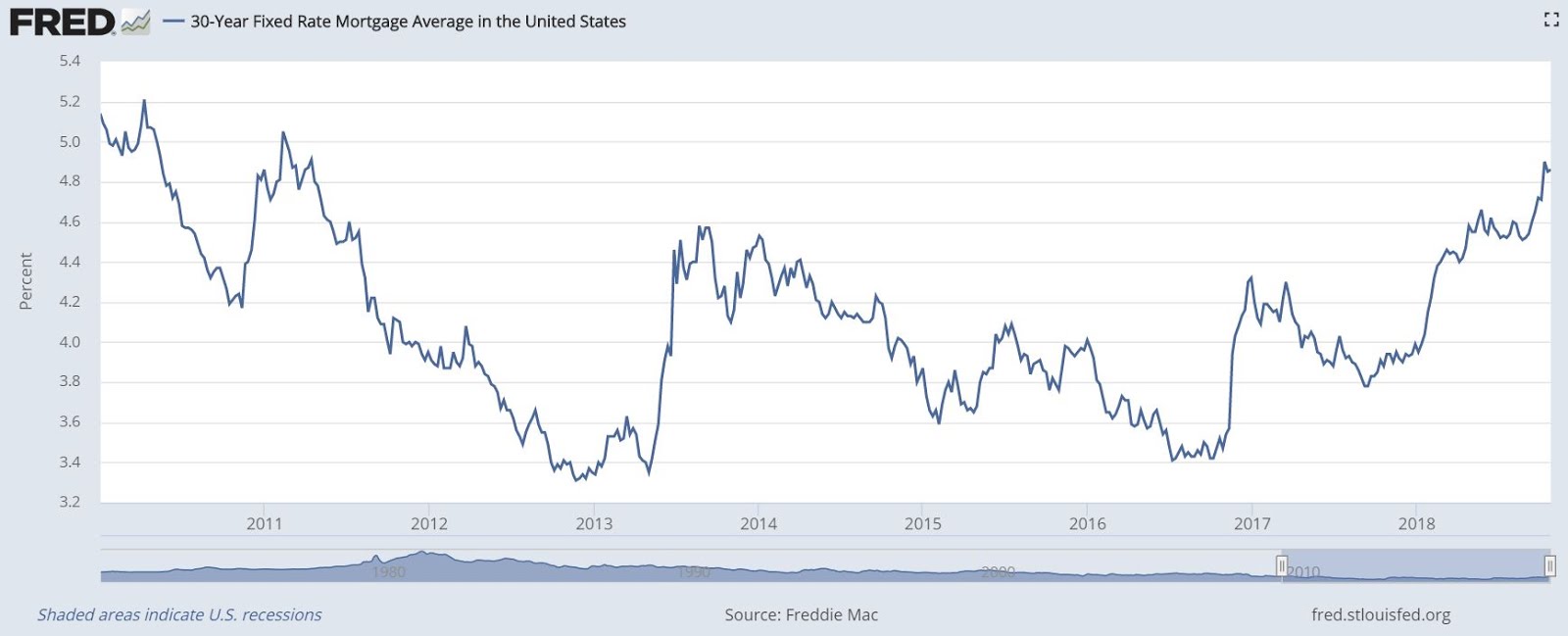
Today I have returned with more data from Freddie Mac and when we look at the broad picture and compare it to the recent data the rates we have right now are still super low. We had a fairly long period with rates that were at or near all time lows dating all the way back to before WWII. These super low rates were largely produced with subsidies from the federal government. The feds were buying up mortgages to keep the housing market from completely imploding after the severe beating it took in 2009-11.

The real issue is that our economy over the last 15 years has been much more fragile than previous economic cycles. Our national government continues to pile on debt and now it is beginning to become a heavy anchor on the economy. Despite seeing robust growth in the economy, the low rates are a major reason we have the growth. As rates return to "normal" the economy will start to drag again. I am not predicting a recession per se, but interest rates this low are generally not healthy for the financial sector over the long term.

As for housing, we have seen hot real estate markets with 30 year fixed rates in the 7s. The problem right now, especially in high cost markets like the Northeastern US and the West Coast is that many buyers are priced out when rates go up. In more affordable markets rates can continue to rise and buyers will still be able to buy. 

Home ownership is still one of the best ways that a middle income earner can build wealth. With rates low, that wealth builds faster. Equity is gained more quickly with lower rates than with higher rates because mortgages are amortized and the lower rates mean more principle is applied with each payment.

The media does not always present the facts in their entirety and home affordability has many variables. income, interest rates, housing prices are major players and all of them need to be accounted when determining affordability. In 1971 the median household income in the US was $10,383 average Freddie Mac mortgage rate of 7.3%, and median home price of $24,500. In 2016 the numbers looked like this: $83,143 median income, 3.75% mortgage rate, $213,700 median home price. The median home cost 2.36 times annual income in 1971 versus 2016 where it was 2.57 times annual income. Housing prices has outpaced income growth but not by the huge margins many people think. When we apply the interest rates however actual cost of ownership is lower today than it was back in 1971. Assuming zero down, the payment on the median home in 1971 at the average rate was, $168 a month against an monthly income of $865 for a principle and interest housing payment of 19.4% of gross income. 2016 median principle and interest payment of $990 against month gross income of $6,929 yields 14.3%. The median home is cheaper today than it was in 1971 because rates are low. These are national averages and generalizations, of course, but it is important to keep in mind that now is still a great time to buy a house. Someday we may look back at the last few years as the "good 'ole days".

Any rate under 6.5% is still, historically speaking, a low rate. Our government needs to stop overspending and that seems to be something that everyone agrees on yet regardless of which political party is in power, the feds can't seem to stop spending more than they take in.

Since 2010 mortgage rates have been volatile but have never gotten very high. Average Freddie Mac par rates have not been above 5% since 2010. Remember that par rates are based on top tier credit and no cash rebates from lender. Right now, Freddie has the national average rates at 4.86% but this is for a strong borrower with no rebate. Rebate is a term to describe a payment the mortgage investor pays back to the borrower used towards the closing costs. Typically rates paid by a buyer is a little higher than these published figures. So as rates have crept up all year, they are still lower than they were in 2010 and well below the established average since 1971 which is roughly 7%.

That stated, rates are sitting at around 5ish, and that is still pretty darn low. Buyers that are playing the waiting game may find themselves in a worse position next year than they are now even as prices are softening. Higher rates will erode purchasing power faster than rising prices. Higher rates also slow down the speed at which equity is gained.

Friday, July 27, 2018

Economy Should Keep Demand up on Real Estate

The latest economic numbers are out and the second quarter produced a strong 4.1% annualized expansion rate. This is going to increase consumer and commercial confidence as well as job expansion. These kinds of economic conditions almost always benefit the real estate market.

Although interest rates have been creeping up all year long it cannot be overstated that rates remain well below the established 50 year average. Long term mortgages continue to offer excellent investment opportunity in both residential and commercial real estate with a cheap cost of money value proposition.

In our local market we still have a shortage of apartments and that shortage is being addressed with massive numbers of units under construction right now. More locally, Vancouver USA has a variety of apartments from luxury units to affordable units coming online to alleviate tremendous pressure on the rental market. That may make some of the owners of older complexes tear up as they may actually have to return to more market rates as these newer units come online.

In the resale homes market I am continuing to see more new listings than new pending sales and that indicates a trend towards more inventory. These things take time to develop especially when considering that the Portland - Vancouver Metro area has had one of the tightest inventories of rentals and resale properties in the whole country over the last few years. 

If the trend plays out to the end of the year buyers will have the upper hand across all price segments except the ultra tight sub $300k range. As long as the economy continues to produce strong gains and employment remains at or near full levels, the real estate market will enjoy success. I do hope we can continue with this trend of 3% or better growth quarter in and quarter out. It all bodes well for real estate and life in general.

Friday, March 24, 2017

#200 How did that happen?

Well a few years ago I changed my monthly real estate newsletter that went out in email form to a weekly Real Estate Blog. Look at that! Issue 200 on this blog has already arrived. Yikes! I do thank all of you for reading this blog.

I do hope you have all found useful information regarding the state of our industry both locally and nationally. I do strive to bridge the gap between facts and conjecture. There is always going to be a great deal of speculation in an industry as influential and popular as real estate.

Speaking of speculation, interest rates are on the minds of many these days. There is a lot of chatter coming out of the financial world about where mortgage rates are heading on the news of a hike in the fed rate over the next few cycles. The Fed Rate doesn't have nearly as much direct influence on mortgages as many people think. It does have a significant indirect effect in that it signals to the markets at large the government's relative attitude regarding the state of the economy.

The Fed Rate (Federal Funds Rate) is a short term interest rate. In fact it is the rate at which banks charge each other for overnight loans. The reason banks make these overnight loans is due to Federal government regulations requiring them to have a certain amount of cash on hand at the end of every business day. Since banks are constantly moving money around, making loans and receiving deposits, they often find themselves short of the government regulated minimums and other banks are in excess of those minimums as billions of dollars move from bank to bank.

The reality is, it doesn't directly effect any long term lending. It does effect short term lending. The reason so many people in the industry point to it as if it were a direct influence is due to the reason the Fed Rate rises. The Fed's action is often due to a rise in inflation and is often raised in an attempt to slow the release of ready cash into the economy.

Generally when the stock market is hot, investors are less interested in collateralized long term debt as an investment. Making 3%-5% annually on mortgage debt is great in a bear market or in a less robust stock market. But when the wall street bull is running the big money starts to gravitate towards stocks and that means lenders need to "entice" the investors with more generous rates of return.

As far as long term mortgage rates are concerned, I have been warning that the 3% party was going to end. In all honesty, it lasted WAY longer than I ever expected. Frankly, it is a testament to the fact the the recovery from the 2008-09 crash was much slower than our slick politicians in Washington DC were willing to admit.

The bottom line on mortgage rates is this. Over the last 70 years rates on 30 year real estate notes has averaged around 6.5%. We had historic highs in the 1980s when mortgages were deep into the teens and historic lows just recently when 30 year money was available in the low threes.

Buyers need to recognize that over the long haul paying a higher mortgage rate will hurt them more than paying a higher price for a home. This market offers no favors to those sitting on the fence. Sellers likewise need to recognize that the robust seller's market will slow a bit as interest rates rise. This means they need to drop the attitude that leads them to believe they don't need to accommodate buyers, and follow best practices for selling a home.

Our real estate market locally in Clark County has a much different dynamic than the market in bordering, Portland, OR. Portland is built -out. They only have infill and re-development options. There is no "new dirt" in Portland. They will likely continue to see pressure on the resale market. Here in Clark County, we do have available, buildable land. The builders are here and the nails are being hammered in. This puts real limits on the resale growth potential as new homes will always carry more value than resales, all else being equal. Right now the median home price county-wide is just above $300k. New homes are widely available in the $325-400k range and that means it will be hard to push a similar 20 year old resale much above the current median mark.

Additionally wages have not kept up with home prices locally and that will begin to slow the rate of new buyers coming into the market. Sellers need to decide whether to sell now or hold tight, but the future is uncertain where the now is known. Right now, we have a modest number of buyers seeking homes from a severely restricted inventory. This is good for sellers now, but when other homeowners decide to sell before rates get too high, inventory will swell and the sellers market will become more neutral. Now is a great time to sell that house and get your new home while rates are still low.

Thanks for helping me reach 200 posts and here's to the march to a thousand!

Friday, January 27, 2017

Robust Economic Acceleration Equals Higher Interest Rates

The engine of the American economy is starting to fire on all cylinders. The DJI average busted up over 20k for the first time ever this week and the 'bull' is on the loose. Companies seem to be poised for expansion and hiring; all of this leads to strong economic growth. That is a good thing and will be much needed relief to the anemic post-recession economy.

There is of course a slight downside. Strong bull economies lead almost invariably to higher interest rates. As with everything in capitalistic economies, the market is based largely on supply and demand. As the stock market begins to soak up cash to chase the bull, interest bearing bonds, bank accounts and home loans begin to look less attractive. Rates rise to increase the demand and thus buying a home with borrowed funds becomes more expensive.

Buyers are in a precarious place of having to deal with stingy sellers and the threat of rising rates. Losing a deal by bickering over a few grand with the seller could cost tens of thousands later, in the form of a 1/2 point spike in rates.

I have written many times on this blog that higher interest rates are a much bigger deterrent than price. Any rate under 5% is historically a FANTASTIC rate and any rate under 6% is still historically better than average. But I fear Americans have gotten used to the 3.5%-4.5% mortgages we have had for the last 5-6 years. People under 35 can't remember rates much higher than 5%. The last ten years has been an aberration caused by a sluggish economic growth rate and a huge recession in 2008-2009.

Buyers that lock in a low sub-five rate will be dancing for joy a few years from now when rates are back in the "normal" range of the low 6's.  Back in 2015 I went into extensive detail about rate versus price; check that article out here : "Rate Usually Beats Price" February 9th, 2015.

Friday, September 26, 2014

Economic Indicators are Trending Up; "Op Window" is Closing

Many market analysts are mildly bullish on the numbers coming out of the marketplace as we enter the final quarter of 2014. For me personally as a Realtor®, this was my strongest year ever. I enjoyed sales that were even better than the pre-crash heyday of the mid-2000s. Low interest rates and improving consumer confidence has made conditions for real estate ripe over the last two years. In 2011 through the middle of 2013 the first time home buyer segment was roaring. Prices were still a little depressed and rates were low so people that had been long priced out of the market saw a rare opportunity to own real estate. Economic recovery and confidence has led to a spill over into the middle and upper end markets.

Looking forward; the strong potential for the economy to swing into a more robust growth could lead to rising interest rates. If the rates get too high, they can have a negative effect on real estate sales and appreciation can slow. The "op window" for many buyers may be closing. Prices have swollen over the last two years by nearly 20%. If rates were to get closer to the 30 year average and settle in at 6%-6.5%, many entry level buyers will find themselves priced out. A strong economy is a good thing and even higher interest rates are worth having when strong job growth and higher incomes are part of the equation. Right now, buyers are in the open window of opportunity. They can lock in a low interest rate that can save them tens of thousands of dollars over the life of the loan before the improving economy drives prices and rates up.

Fear and uncertainty are what keep people from buying real estate. But no matter what, people need a place to live and buying right now for many people is just as affordable as renting. As the economic conditions improve the cost to own will rise faster than the cost of rent and that window will close as well. It is a good time to buy and a good time to sell.  

This was published by Kiplinger this month:

By David Payne

The economy looks better than was previously thought: Look for about 3.5% growth at an annual rate in the third quarter, driven by motor vehicle sales, business equipment, exports and nonresidential construction. A likely upward revision of second-quarter growth to near 5.0% after a dismal first quarter (a -2.1% growth rate) is also likely. In the fourth quarter and into 2015, growth should settle down to a 3.0% rate. That would mean average GDP this year would be about 2.2% over the average for 2013.

Setting the stage for more sustained growth in coming months: After wringing out inflation, disposable income grew at a strong 4.0% annualized rate from December 2013 through July 2014. Consumer confidence is at its highest level since before the recession. Motor vehicle sales in July hit their highest level in over eight years. An index of manufacturing activity points to strongly expanding output. New orders for business equipment have climbed 13 percent at an annual rate since May, indicating strength in business investment spending. Plus, hiring is on the rise, layoffs are scarce (indicated by a very low rate of initial unemployment claims since May), and retail sales have rebounded.

And growth may accelerate more dramatically through 2015. Improving business confidence could push investment growth back up. Consumer spending and confidence remain below what would be considered normal levels by the standards of past economic expansions. As job growth returns and consumers feel more secure, more robust income and spending increases may well be triggered, pushing second-half growth over the expected 3% pace. While that happening in what remains of this year is an outside chance, it’s a good bet that in 2015 such a virtuous cycle will kick in.

There is a slight possibility that rising interest rates next year could have a mild depressive effect, knocking growth down from an above-average (better than a 3%) rate to a simply average (2.5%) pace. For now, however, we expect that the likely small increase of a quarter- or half-percentage point in rates won’t have much impact on GDP growth.

Friday, March 7, 2014

Rate of Foreclosure Down, Very Good Indeed.

The rate at which banks are foreclosing on property has dropped substantially over the last twelve months. In general this is of course a very good thing indeed. The National Association of Realtors® has published an article on foreclosure data with which a link to the public portion is included below. Generally foreclosure rates run under 1% in a healthy market and many markets are already at or below 1% foreclosure rate.

Low foreclosure rates inspire buyer confidence and keep under market priced 'as-is' REO from undermining local prices. This can help move the market upward.

Not everyone however benefits from reduced foreclosures. Investors looking for non-financable homes at a bargain price are beginning to feel the pinch caused by a lack of inventory. The last thing a real estate investor wants is competition from an owner occupant buyer. Owner occupants typically use financing from a bank so investors can capitalize on cash only properties without a primary residence buyer inflating the price.

All of that aside, lower foreclosure rates is good for the market and good for the economy.


Public version of the NAR article on foreclosures at the link below.
Foreclosure Rates and Changes: Q4 2013 vs. Q4 2012