Mortgage rates have managed to stay low and in some cases dip a bit lower still. The combination of a pandemic and now civil unrest has not been too disruptive tot he local real estate market nor seemingly the lending aspect of real estate.
When rates dip low that reveals a wonderful opportunity for buyers to get a lower payment or to afford a larger or nicer home without paying more money for it. Generally low rates lead to an uptick in activity for buyers and thus a rising price condition. However, COVID-19 has managed to keep a lid on prices. The recent civil unrest may also help keep prices in check. For buyers this is good news a combination of low rates and stable pricing is always a good thing.
Buyers thinking about a home should get started now because rates will only remain low while investors are leery of equities. Furthermore as COVID-19 response restrictions are eased more buyers are likely to emerge and the market could potentially see a return to upward pricing.
Mortgage lenders seem to be handling the COVID-19 well in underwriting. The tendency in a downward job market is for lenders to become more tight with buyers. So far it seems only marginal. Other lending lines like credit cards and car loans are getting real stingy.
This is a strange set of conditions we see now so buckle up and enjoy the ride.

Musings on the state of the market with tips, information and a little fun.
Showing posts with label rates. Show all posts
Showing posts with label rates. Show all posts
Friday, June 5, 2020

Friday, February 28, 2020
Wall Street Takes Profits, Mortgage Rates Dive Lower!
This has been a brutal week for stocks with the Dow Jones shedding more than 4000 points since Monday. Investors are taking profits and covering margin calls, but enough money flew towards mortgage securities to show a significant improvement over the course of the week. I wouldn't be surprised if loan officers all across the fruited plain have sore fingers from clicking the "rate lock" button all day today.
If you are a buyer your purchasing power improved this week and that means either more house or a lower payment, maybe even BOTH! My two cents is that the stock market was a bit over valued , and adding the Corona virus fears was the proverbial straw that broke the camel's back. Once the Corona situation settles down the market will return to a robust improvement. The basic economic indicators are very solid and that should lead to a recovery in the markets by the middle of Q2. If I'm right then mortgage rates may start to creep up again around late May or June.
I don't expect to see any dramatic mortgage rate increases at all in 2020, but even a slight upward tick can drop a buyer's purchasing power by several thousand dollars. Sellers still hold the advantage in the local market under $500,000 so buyers need all the help they can get. Wall Street just handed buyers a an early Christmas present.
If you are a buyer your purchasing power improved this week and that means either more house or a lower payment, maybe even BOTH! My two cents is that the stock market was a bit over valued , and adding the Corona virus fears was the proverbial straw that broke the camel's back. Once the Corona situation settles down the market will return to a robust improvement. The basic economic indicators are very solid and that should lead to a recovery in the markets by the middle of Q2. If I'm right then mortgage rates may start to creep up again around late May or June.
I don't expect to see any dramatic mortgage rate increases at all in 2020, but even a slight upward tick can drop a buyer's purchasing power by several thousand dollars. Sellers still hold the advantage in the local market under $500,000 so buyers need all the help they can get. Wall Street just handed buyers a an early Christmas present.
Friday, January 3, 2020
Happy New Year: 2020 Real Estate Outlook
Well here we are again in the US another presidential election cycle... yay... you feel the lack of enthusiasm? I will not venture into politics here but I will encourage everyone of legal voting age to vote. So presidential election years often lead to flat economic conditions. It seems the closer we get to the election the more reservations in the financial markets. This has stood the test of time immemorial. This is not to say that recessions result, rather quite the contrary, things tend to stay in the status quo. So the 2020 economic outlook is more or less the same which has been fairly strong of late.
Residential real estate however is a notable exception. Most residential real estate is individuals buying or selling their own private property. They are impacted by supply and demand as well as capital markets such as mortgage banking and construction finance, but residential buyers and sellers decisions are based on their personal needs and situation at that moment in time, elections be damned.
The outlook for real estate in SW Washington remains positive with 2020 quite likely to continue this trend of near neutral market conditions and modest year over year price growth. Sales volume has been rather brisk over the last 12 months almost as if the market were favoring sellers, yet the market favors neither sellers or buyers in a broad sense. Individual macro markets are all over the board with high end properties facing more buyer resistance and entry level properties still firmly in favor of sellers.
The trend over the last several months has been running between 650-750 closed transactions every month in Clark County, which is rather healthy. I think we may see a slow down in overall new construction in the single family homes market, but a continued build up of urban properties like apartment towers and condo towers downtown and on the urban corridors.
Expect interest rates to be relatively flat and sales to continue at a brisk pace. 2020 ought to be a strong year in real estate that should be positive for both buyers and sellers.
Happy New Year!
Residential real estate however is a notable exception. Most residential real estate is individuals buying or selling their own private property. They are impacted by supply and demand as well as capital markets such as mortgage banking and construction finance, but residential buyers and sellers decisions are based on their personal needs and situation at that moment in time, elections be damned.
The outlook for real estate in SW Washington remains positive with 2020 quite likely to continue this trend of near neutral market conditions and modest year over year price growth. Sales volume has been rather brisk over the last 12 months almost as if the market were favoring sellers, yet the market favors neither sellers or buyers in a broad sense. Individual macro markets are all over the board with high end properties facing more buyer resistance and entry level properties still firmly in favor of sellers.
The trend over the last several months has been running between 650-750 closed transactions every month in Clark County, which is rather healthy. I think we may see a slow down in overall new construction in the single family homes market, but a continued build up of urban properties like apartment towers and condo towers downtown and on the urban corridors.
Expect interest rates to be relatively flat and sales to continue at a brisk pace. 2020 ought to be a strong year in real estate that should be positive for both buyers and sellers.
Happy New Year!
Friday, November 8, 2019
Stock Market Rally Pushed Rates Up!
 It is not uncommon at all, in fact it is quite normal to see mortgage rates move up when the stock market is strong. The last several days saw a tremendous run up on wall street with nearly every index blasting through all time records. Mortgages are competing with stocks for investor cash and equity has been moving to stocks all week. Investors are not looking for higher returns on mortgages and we saw a sharp adjustment yesterday.
Buyers don't need to panic, but this is an example of the potential for volatility in mortgages and thus the buying power of borrowers. This is a great time of year to buy a house. It tends to be a little more quiet and sellers are anxious about getting an offer before the holidays. Meanwhile sellers can rest assured that the people outside braving the chillier late autumn temps along with rain and snow are serious about buying a house.
Buyers can relax it is only a matter of time before investors start taking profits on all these stock gains and then that money will likely move back into the warm embrace of mortgage securities. This will release some pressure and lower rates again. These last couple of years have been wonderful for mortgages even with this latest uptick. This is not the normal state of mortgage affairs and a return to higher rates is inevitable at some point. Buyers are well advised to strike while the iron is hot and get the home of their dreams while it remains affordable.
Friday, September 6, 2019
Rates Have Tumbled!
Turmoil in markets and a flow of cash to the US have created an opportunity for home buyers. Rates fell last week to near all time lows, although not quite as low as a few years ago. That said this will be a temporary lull in rates as things settle out in the markets, rates will normalize again. Buyers should consider taking advantage of the low rates as even a 1/4 point reduction in loan rate can add thousands of dollars in purchasing power.
I have written ad nauseum about the virtues of rate over price. Price is fleeting but rates are forever. Well, 30 years of forever at least. Saving a few thousand on price is nowhere near as important as capitalizing on a rate savings of 1/4 to 1/2 percent. Do not underestimate the power of low rates.
This article I wrote back a few years ago and it still holds true today. I even dedicated an entire chapter to mortgage rates and home prices in my 2010 book, Don't Panic.
originally published July 6th, 2018 by Rod Sager
I have spared no lines of text on the issue of higher interest. Rising interest rates will severely effect buyers ability to purchase a home if they are not using cash. Buyers will enjoy a a flattening price market, but they will not enjoy having their dollars stretched thin by rising rates. 6 of one half-dozen of the other?
Let's say we offer $350,000 on a house now with rates at 4.5% FHA. Buyer will need $12,250 cash down. The PI payment (principle and interest) is $1,711 per month for 30 years. Now the property taxes and mortgage insurance will be added to the payment as well, but interest rates do not directly effect those values. If a buyer waits a couple of months to offer they may find a similar home priced at $355,000. Now if rates remained the same the down payment is now $12,425 and the new estimated PI payment is $1,736 per month for 30 years. That's not so bad, right just $25 a month more. Well, sort of, over thirty years that's $9,000! But this year rates have been slowly climbing so it is far more likely rates will have risen over the next couple of months and probably that 4.5% now will cost 4.75%. With the higher rate, the payment moves up to $1,787 per month. That's $76 per month MORE for 30 years which adds up to $27,360.
Most importantly is that the rising rates was more damaging than the rising prices. The amount of additional monthly income required to qualify for an extra $76 a month payment is going to be $160-$230 depending on the loan type and credit profile. Many buyers get priced out on rates rather than actual home appreciation values.
It is important to remember that loan officers will give an approval based on the price of the house, but the underwriter is actually approving a monthly payment not a purchase price. The loan officer converts the payment into a price to make shopping a little easier for the buyer.
It is very important to understand that the average mortgage rate has been very low for nearly 10 years. In fact The 46 year average Freddie Mac 30 year fixed rate dating back to 1972 is over 8% So even as rates rise into the fives they are still historically low.
The chart below shows the loss of purchasing power as rates rise. Please note the chart is only looking at Principle and Interest and not the combined payment including taxes and insurance. Rising or falling rates won't directly effect the taxes and insurance. The chart shows an FHA loan with a maximum approved PI payment of $1,500. The actual payment on this loan with taxes and insurance would be closer to $2000. The moral of this story is buyers should take advantage of these low rates while they can.

I have written ad nauseum about the virtues of rate over price. Price is fleeting but rates are forever. Well, 30 years of forever at least. Saving a few thousand on price is nowhere near as important as capitalizing on a rate savings of 1/4 to 1/2 percent. Do not underestimate the power of low rates.
This article I wrote back a few years ago and it still holds true today. I even dedicated an entire chapter to mortgage rates and home prices in my 2010 book, Don't Panic.
originally published July 6th, 2018 by Rod Sager
I have spared no lines of text on the issue of higher interest. Rising interest rates will severely effect buyers ability to purchase a home if they are not using cash. Buyers will enjoy a a flattening price market, but they will not enjoy having their dollars stretched thin by rising rates. 6 of one half-dozen of the other?
Let's say we offer $350,000 on a house now with rates at 4.5% FHA. Buyer will need $12,250 cash down. The PI payment (principle and interest) is $1,711 per month for 30 years. Now the property taxes and mortgage insurance will be added to the payment as well, but interest rates do not directly effect those values. If a buyer waits a couple of months to offer they may find a similar home priced at $355,000. Now if rates remained the same the down payment is now $12,425 and the new estimated PI payment is $1,736 per month for 30 years. That's not so bad, right just $25 a month more. Well, sort of, over thirty years that's $9,000! But this year rates have been slowly climbing so it is far more likely rates will have risen over the next couple of months and probably that 4.5% now will cost 4.75%. With the higher rate, the payment moves up to $1,787 per month. That's $76 per month MORE for 30 years which adds up to $27,360.
Most importantly is that the rising rates was more damaging than the rising prices. The amount of additional monthly income required to qualify for an extra $76 a month payment is going to be $160-$230 depending on the loan type and credit profile. Many buyers get priced out on rates rather than actual home appreciation values.
It is important to remember that loan officers will give an approval based on the price of the house, but the underwriter is actually approving a monthly payment not a purchase price. The loan officer converts the payment into a price to make shopping a little easier for the buyer.
It is very important to understand that the average mortgage rate has been very low for nearly 10 years. In fact The 46 year average Freddie Mac 30 year fixed rate dating back to 1972 is over 8% So even as rates rise into the fives they are still historically low.
The chart below shows the loss of purchasing power as rates rise. Please note the chart is only looking at Principle and Interest and not the combined payment including taxes and insurance. Rising or falling rates won't directly effect the taxes and insurance. The chart shows an FHA loan with a maximum approved PI payment of $1,500. The actual payment on this loan with taxes and insurance would be closer to $2000. The moral of this story is buyers should take advantage of these low rates while they can.

Friday, August 16, 2019
Inverted Yield Curve Aids in Market Panic
Earlier this week the Stock Market shed some 2-3% of its value on one trading day. The DJIA dropped 800 points on Wednesday after the markets showed an inverted yield curve with short term interest rates higher than long term rates. This is sometimes a precursor to a recession and that has investors spooked.
Now the reality is that inverted yield curves do often appear before an economic slowdown, but it is by no means a definitive harbinger. In fact there are many reasons that investors might pour assets into long term bonds and some of that action may of actually been from turbulence in Hong Kong. The US economy is not quite as robust as the White House likes to tout, but it is pretty far from recessionary as well. Employment is maxed, wages continue to climb, and consumer confidence remains high.
The inverted curve is likely to be short lived and the market scare may have provided a convenient opportunity for investors to take profits after record high stock values earlier this summer.
All economics aside, the interest rates on 15 and 30 year mortgage notes will benefit from an inverted curve as long term rates dropped allowing more people to qualify for home loans and pushing the qualifying values higher.
Our local real estate market is a tale of two markets really. Homes priced up above 150% of median are in a bit of an inventory glut and sellers are reducing prices while buyers take their time. Meanwhile in the entry level market at 120% of median and below buyers continue to face stubborn sellers and multiple offers on well priced properties.
Things are actually healthy in the local market with strong sales activity and excellent economic indicators for the next several months, possibly into next year.
Now the reality is that inverted yield curves do often appear before an economic slowdown, but it is by no means a definitive harbinger. In fact there are many reasons that investors might pour assets into long term bonds and some of that action may of actually been from turbulence in Hong Kong. The US economy is not quite as robust as the White House likes to tout, but it is pretty far from recessionary as well. Employment is maxed, wages continue to climb, and consumer confidence remains high.
The inverted curve is likely to be short lived and the market scare may have provided a convenient opportunity for investors to take profits after record high stock values earlier this summer.
All economics aside, the interest rates on 15 and 30 year mortgage notes will benefit from an inverted curve as long term rates dropped allowing more people to qualify for home loans and pushing the qualifying values higher.
Our local real estate market is a tale of two markets really. Homes priced up above 150% of median are in a bit of an inventory glut and sellers are reducing prices while buyers take their time. Meanwhile in the entry level market at 120% of median and below buyers continue to face stubborn sellers and multiple offers on well priced properties.
Things are actually healthy in the local market with strong sales activity and excellent economic indicators for the next several months, possibly into next year.
Friday, August 9, 2019
Interest Rates a bit Lower to start the Month
While I was away in the UK it seems that the mortgage rates decided to drop a bit. This is always welcome in the real estate business. After all it is challenging enough to buy a house, getting a bonus reduction in monthly payment is going help bring some buyers back to the game.
With rates still readily available in the 4's and some area and situations may even land a buyer into the upper threes on interest rates, this could be the time to start looking again for that dream house you got priced out of earlier this year.
While I was away in the UK I found that they have popularized a 25 year mortgage loan and the rates there are under 2%! Holy moly, that's a low rate. I wonder if the government is subsidizing that? Well anyhow, back here in the states, we are enjoying a booming economy and some pretty low rates as well.
With rents still pushing up higher than a comparable mortgage payment, why not fire the landlord and buy your own place?
Just to keep it all in perspective, mortgage rates dropped over the last two weeks by about a 1/4 point. That 1/4 point rate drop saves a typical borrower about 50 bucks a month for the next 30 years on a $300,000 mortgage! That's about $18,000 over the life of the loan. The cost to buy down a mortgage by a 1/4 percent is usually around 1 point although it is entirely market dependent. But that same $300,000 loan would cost about $3,000 up front to buy the rate down two weeks ago to what it is today.
Hello $300k buyers the world just gave you three grand :)
With rates still readily available in the 4's and some area and situations may even land a buyer into the upper threes on interest rates, this could be the time to start looking again for that dream house you got priced out of earlier this year.
While I was away in the UK I found that they have popularized a 25 year mortgage loan and the rates there are under 2%! Holy moly, that's a low rate. I wonder if the government is subsidizing that? Well anyhow, back here in the states, we are enjoying a booming economy and some pretty low rates as well.
With rents still pushing up higher than a comparable mortgage payment, why not fire the landlord and buy your own place?
Just to keep it all in perspective, mortgage rates dropped over the last two weeks by about a 1/4 point. That 1/4 point rate drop saves a typical borrower about 50 bucks a month for the next 30 years on a $300,000 mortgage! That's about $18,000 over the life of the loan. The cost to buy down a mortgage by a 1/4 percent is usually around 1 point although it is entirely market dependent. But that same $300,000 loan would cost about $3,000 up front to buy the rate down two weeks ago to what it is today.
Hello $300k buyers the world just gave you three grand :)
Friday, November 2, 2018
Sales are still strong, But Sellers Beware...
Sellers best take notice, the robust sales are still alive and well in our local market, but buyers have choices and they are not tolerating high prices. This recent uptick in rates has eliminated many buyers from upgrading their home or even buying a home at all. That has taken pressure off the market. There are still plenty of buyers and these rising rates are also helping them "pull the trigger" but with more choices, buyers can be a little more discerning about how much house they can get for what cash they have to play with.
Lenders are also sniffing out the soften demand, and that means appraisers are even more vigilant in finding true comps. Puffed up values are not going to fly in this market. Sellers may miss a golden opportunity to sell if they get too greedy and try a high price. As rates creep up buyers lose buying power and that overpriced listing sits on the market.
A trusted professional realtor® will pull comps and should offer a trend analysis to help sellers determine the effective price range for their property. Most agents want to help sellers get the best price possible, but they also know that sometimes sellers and the market are not on the same page. A year ago sellers could get away with a 10% bump as the market was a raging bull, but now the market is a butterfly, still flying, but not smashing everything in its path.
We are entering the rainy season here in the Pacific Northwest and that tends to soften the number of buyers out and about looking at houses. Sellers are advised to keep their property free of leaves and other autumn debris and keep that house tidy. The old adage is rings pure: you only get one chance to make a first impression.
Lenders are also sniffing out the soften demand, and that means appraisers are even more vigilant in finding true comps. Puffed up values are not going to fly in this market. Sellers may miss a golden opportunity to sell if they get too greedy and try a high price. As rates creep up buyers lose buying power and that overpriced listing sits on the market.
A trusted professional realtor® will pull comps and should offer a trend analysis to help sellers determine the effective price range for their property. Most agents want to help sellers get the best price possible, but they also know that sometimes sellers and the market are not on the same page. A year ago sellers could get away with a 10% bump as the market was a raging bull, but now the market is a butterfly, still flying, but not smashing everything in its path.
We are entering the rainy season here in the Pacific Northwest and that tends to soften the number of buyers out and about looking at houses. Sellers are advised to keep their property free of leaves and other autumn debris and keep that house tidy. The old adage is rings pure: you only get one chance to make a first impression.
Friday, October 26, 2018
Interest Rates Rising, But Still Relatively Low
I have discussed interest rates often as they tend to be a critical element in the real estate market. For younger buyers these higher rates may seem "high" but in reality our rates still remain well below the established 50 year average. A while back I published some charts and graphs showing the plight of rates over the last 50 years.
 Today I have returned with more data from Freddie Mac and when we look at the broad picture and compare it to the recent data the rates we have right now are still super low. We had a fairly long period with rates that were at or near all time lows dating all the way back to before WWII. These super low rates were largely produced with subsidies from the federal government. The feds were buying up mortgages to keep the housing market from completely imploding after the severe beating it took in 2009-11.
The real issue is that our economy over the last 15 years has been much more fragile than previous economic cycles. Our national government continues to pile on debt and now it is beginning to become a heavy anchor on the economy. Despite seeing robust growth in the economy, the low rates are a major reason we have the growth. As rates return to "normal" the economy will start to drag again. I am not predicting a recession per se, but interest rates this low are generally not healthy for the financial sector over the long term.
As for housing, we have seen hot real estate markets with 30 year fixed rates in the 7s. The problem right now, especially in high cost markets like the Northeastern US and the West Coast is that many buyers are priced out when rates go up. In more affordable markets rates can continue to rise and buyers will still be able to buy.
Home ownership is still one of the best ways that a middle income earner can build wealth. With rates low, that wealth builds faster. Equity is gained more quickly with lower rates than with higher rates because mortgages are amortized and the lower rates mean more principle is applied with each payment.
The media does not always present the facts in their entirety and home affordability has many variables. income, interest rates, housing prices are major players and all of them need to be accounted when determining affordability. In 1971 the median household income in the US was $10,383 average Freddie Mac mortgage rate of 7.3%, and median home price of $24,500. In 2016 the numbers looked like this: $83,143 median income, 3.75% mortgage rate, $213,700 median home price. The median home cost 2.36 times annual income in 1971 versus 2016 where it was 2.57 times annual income. Housing prices has outpaced income growth but not by the huge margins many people think. When we apply the interest rates however actual cost of ownership is lower today than it was back in 1971. Assuming zero down, the payment on the median home in 1971 at the average rate was, $168 a month against an monthly income of $865 for a principle and interest housing payment of 19.4% of gross income. 2016 median principle and interest payment of $990 against month gross income of $6,929 yields 14.3%. The median home is cheaper today than it was in 1971 because rates are low. These are national averages and generalizations, of course, but it is important to keep in mind that now is still a great time to buy a house. Someday we may look back at the last few years as the "good 'ole days".
 Any rate under 6.5% is still, historically speaking, a low rate. Our government needs to stop overspending and that seems to be something that everyone agrees on yet regardless of which political party is in power, the feds can't seem to stop spending more than they take in.
Since 2010 mortgage rates have been volatile but have never gotten very high. Average Freddie Mac par rates have not been above 5% since 2010. Remember that par rates are based on top tier credit and no cash rebates from lender. Right now, Freddie has the national average rates at 4.86% but this is for a strong borrower with no rebate. Rebate is a term to describe a payment the mortgage investor pays back to the borrower used towards the closing costs. Typically rates paid by a buyer is a little higher than these published figures. So as rates have crept up all year, they are still lower than they were in 2010 and well below the established average since 1971 which is roughly 7%.
That stated, rates are sitting at around 5ish, and that is still pretty darn low. Buyers that are playing the waiting game may find themselves in a worse position next year than they are now even as prices are softening. Higher rates will erode purchasing power faster than rising prices. Higher rates also slow down the speed at which equity is gained.

The real issue is that our economy over the last 15 years has been much more fragile than previous economic cycles. Our national government continues to pile on debt and now it is beginning to become a heavy anchor on the economy. Despite seeing robust growth in the economy, the low rates are a major reason we have the growth. As rates return to "normal" the economy will start to drag again. I am not predicting a recession per se, but interest rates this low are generally not healthy for the financial sector over the long term.
As for housing, we have seen hot real estate markets with 30 year fixed rates in the 7s. The problem right now, especially in high cost markets like the Northeastern US and the West Coast is that many buyers are priced out when rates go up. In more affordable markets rates can continue to rise and buyers will still be able to buy.
Home ownership is still one of the best ways that a middle income earner can build wealth. With rates low, that wealth builds faster. Equity is gained more quickly with lower rates than with higher rates because mortgages are amortized and the lower rates mean more principle is applied with each payment.
The media does not always present the facts in their entirety and home affordability has many variables. income, interest rates, housing prices are major players and all of them need to be accounted when determining affordability. In 1971 the median household income in the US was $10,383 average Freddie Mac mortgage rate of 7.3%, and median home price of $24,500. In 2016 the numbers looked like this: $83,143 median income, 3.75% mortgage rate, $213,700 median home price. The median home cost 2.36 times annual income in 1971 versus 2016 where it was 2.57 times annual income. Housing prices has outpaced income growth but not by the huge margins many people think. When we apply the interest rates however actual cost of ownership is lower today than it was back in 1971. Assuming zero down, the payment on the median home in 1971 at the average rate was, $168 a month against an monthly income of $865 for a principle and interest housing payment of 19.4% of gross income. 2016 median principle and interest payment of $990 against month gross income of $6,929 yields 14.3%. The median home is cheaper today than it was in 1971 because rates are low. These are national averages and generalizations, of course, but it is important to keep in mind that now is still a great time to buy a house. Someday we may look back at the last few years as the "good 'ole days".
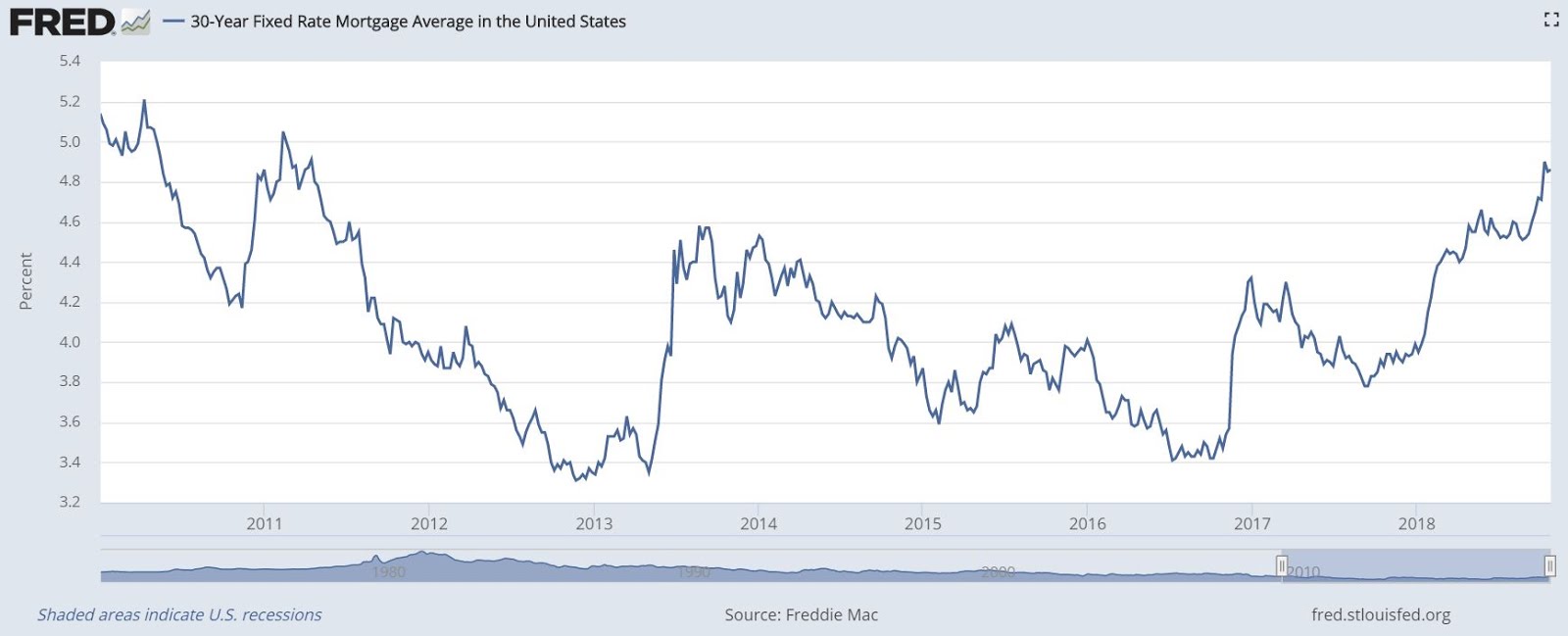
Since 2010 mortgage rates have been volatile but have never gotten very high. Average Freddie Mac par rates have not been above 5% since 2010. Remember that par rates are based on top tier credit and no cash rebates from lender. Right now, Freddie has the national average rates at 4.86% but this is for a strong borrower with no rebate. Rebate is a term to describe a payment the mortgage investor pays back to the borrower used towards the closing costs. Typically rates paid by a buyer is a little higher than these published figures. So as rates have crept up all year, they are still lower than they were in 2010 and well below the established average since 1971 which is roughly 7%.
That stated, rates are sitting at around 5ish, and that is still pretty darn low. Buyers that are playing the waiting game may find themselves in a worse position next year than they are now even as prices are softening. Higher rates will erode purchasing power faster than rising prices. Higher rates also slow down the speed at which equity is gained.
Friday, July 27, 2018
Economy Should Keep Demand up on Real Estate
The latest economic numbers are out and the second quarter produced a strong 4.1% annualized expansion rate. This is going to increase consumer and commercial confidence as well as job expansion. These kinds of economic conditions almost always benefit the real estate market.
Although interest rates have been creeping up all year long it cannot be overstated that rates remain well below the established 50 year average. Long term mortgages continue to offer excellent investment opportunity in both residential and commercial real estate with a cheap cost of money value proposition.
In our local market we still have a shortage of apartments and that shortage is being addressed with massive numbers of units under construction right now. More locally, Vancouver USA has a variety of apartments from luxury units to affordable units coming online to alleviate tremendous pressure on the rental market. That may make some of the owners of older complexes tear up as they may actually have to return to more market rates as these newer units come online.
In the resale homes market I am continuing to see more new listings than new pending sales and that indicates a trend towards more inventory. These things take time to develop especially when considering that the Portland - Vancouver Metro area has had one of the tightest inventories of rentals and resale properties in the whole country over the last few years.
If the trend plays out to the end of the year buyers will have the upper hand across all price segments except the ultra tight sub $300k range. As long as the economy continues to produce strong gains and employment remains at or near full levels, the real estate market will enjoy success. I do hope we can continue with this trend of 3% or better growth quarter in and quarter out. It all bodes well for real estate and life in general.
Although interest rates have been creeping up all year long it cannot be overstated that rates remain well below the established 50 year average. Long term mortgages continue to offer excellent investment opportunity in both residential and commercial real estate with a cheap cost of money value proposition.
In our local market we still have a shortage of apartments and that shortage is being addressed with massive numbers of units under construction right now. More locally, Vancouver USA has a variety of apartments from luxury units to affordable units coming online to alleviate tremendous pressure on the rental market. That may make some of the owners of older complexes tear up as they may actually have to return to more market rates as these newer units come online.
In the resale homes market I am continuing to see more new listings than new pending sales and that indicates a trend towards more inventory. These things take time to develop especially when considering that the Portland - Vancouver Metro area has had one of the tightest inventories of rentals and resale properties in the whole country over the last few years.
If the trend plays out to the end of the year buyers will have the upper hand across all price segments except the ultra tight sub $300k range. As long as the economy continues to produce strong gains and employment remains at or near full levels, the real estate market will enjoy success. I do hope we can continue with this trend of 3% or better growth quarter in and quarter out. It all bodes well for real estate and life in general.
Friday, July 6, 2018
Rates and Purchasing Power
I have spared no lines of text on the issue of higher interest. Rising interest rates will severely effect buyers ability to purchase a home if they are not using cash. Buyers will enjoy a a flattening price market, but they will not enjoy having their dollars stretched thin by rising rates. 6 of one half-dozen of the other?
Let's say we offer $350,000 on a house now with rates at 4.5% FHA. Buyer will need $12,250 cash down. The PI payment (principle and interest) is $1,711 per month for 30 years. Now the property taxes and mortgage insurance will be added to the payment as well, but interest rates do not directly effect those values. If a buyer waits a couple of months to offer they may find a similar home priced at $355,000. Now if rates remained the same the down payment is now $12,425 and the new estimated PI payment is $1,736 per month for 30 years. That's not so bad, right just $25 a month more. Well, sort of, over thirty years that's $9,000! But this year rates have been slowly climbing so it is far more likely rates will have risen over the next couple of months and probably that 4.5% now will cost 4.75%. With the higher rate, the payment moves up to $1,787 per month. That's $76 per month MORE for 30 years which adds up to $27,360.
Most importantly is that the rising rates was more damaging than the rising prices. The amount of additional monthly income required to qualify for an extra $76 a month payment is going to be $160-$230 depending on the loan type and credit profile. Many buyers get priced out on rates rather than actual home appreciation values.
It is important to remember that loan officers will give an approval based on the price of the house, but the underwriter is actually approving a monthly payment not a purchase price. The loan officer converts the payment into a price to make shopping a little easier for the buyer.
It is very important to understand that the average mortgage rate has been very low for nearly 10 years. In fact The 46 year average Freddie Mac 30 year fixed rate dating back to 1972 is over 8% So even as rates rise into the fives they are still historically low.
The chart below shows the loss of purchasing power as rates rise. Please note the chart is only looking at Principle and Interest and not the combined payment including taxes and insurance. Rising or falling rates won't directly effect the taxes and insurance. The chart shows an FHA loan with a maximum approved PI payment of $1,500. The actual payment on this loan with taxes and insurance would be closer to $2000. The moral of this story is buyers should take advantage of these low rates while they can.
Let's say we offer $350,000 on a house now with rates at 4.5% FHA. Buyer will need $12,250 cash down. The PI payment (principle and interest) is $1,711 per month for 30 years. Now the property taxes and mortgage insurance will be added to the payment as well, but interest rates do not directly effect those values. If a buyer waits a couple of months to offer they may find a similar home priced at $355,000. Now if rates remained the same the down payment is now $12,425 and the new estimated PI payment is $1,736 per month for 30 years. That's not so bad, right just $25 a month more. Well, sort of, over thirty years that's $9,000! But this year rates have been slowly climbing so it is far more likely rates will have risen over the next couple of months and probably that 4.5% now will cost 4.75%. With the higher rate, the payment moves up to $1,787 per month. That's $76 per month MORE for 30 years which adds up to $27,360.
Most importantly is that the rising rates was more damaging than the rising prices. The amount of additional monthly income required to qualify for an extra $76 a month payment is going to be $160-$230 depending on the loan type and credit profile. Many buyers get priced out on rates rather than actual home appreciation values.
It is important to remember that loan officers will give an approval based on the price of the house, but the underwriter is actually approving a monthly payment not a purchase price. The loan officer converts the payment into a price to make shopping a little easier for the buyer.
It is very important to understand that the average mortgage rate has been very low for nearly 10 years. In fact The 46 year average Freddie Mac 30 year fixed rate dating back to 1972 is over 8% So even as rates rise into the fives they are still historically low.
The chart below shows the loss of purchasing power as rates rise. Please note the chart is only looking at Principle and Interest and not the combined payment including taxes and insurance. Rising or falling rates won't directly effect the taxes and insurance. The chart shows an FHA loan with a maximum approved PI payment of $1,500. The actual payment on this loan with taxes and insurance would be closer to $2000. The moral of this story is buyers should take advantage of these low rates while they can.
Friday, March 30, 2018
How will Rising Rates Tug on our Market?
Since the beginning of the year mortgage rates have been on a rather steady upswing. It's not like they have launched into space, but rather just a slow and steady rise. The 4th quarter of last year more than 3% GDP growth and that was the best quarter since the economic crash in 2009. This is putting upward pressure on rates. A strong economy is nearly always met with higher interest rates.
For the real estate market, higher mortgage rates are a real braking device. A buyer looking at a $300,000 mortgage can expect to pay a principle and interest payment of $1347 at 3.5%. This of course doesn't include taxes and insurance but those are not readily affected by rates. At 4.5% that same $300,000 loan has a PI payment of $1520. At 5.5% it rises to $1703. A $356 increase in payment generally will require an additional $700 to $1000 in monthly income to qualify. Even if housing prices stay flat and do not change, buyers will lose buying power as rates continue upward.
Most analysts are expected the price appreciation to soften in 2018 to around 3% - 5%. Even at the low end of that scale a $315,000 house will be $324,450 in a year. If a buyer can get 4.25% today that house with 15K down will have a PI payment of $1476 plus a few hundred more in taxes and insurance. Next year at the low end of analysts projections the same house will have a PI payment of $1657. That is more than $200 a month more expensive. That means at least $500 a month in additional income to qualify.
I still find buyers that are resistant to this concept and often they find themselves priced out of the market or settling for way less house than they would have been able to afford had they acted earlier. The worst part is that over time the interest rate does much more financial damage than paying a higher price. The rate of principle reduction is slower, the total amount of interest paid is much higher. In fact, a $300,000 mortgage at 4.5% will have a total of 360 payments of $1520 for $547,200. At 5.25% it's 360 payments of $1657 for $596,520. So just three quarters of one percent leads to $50,000 more in payments over time.
Rates are on the rise, so it's time to buy or die. So to speak.
For the real estate market, higher mortgage rates are a real braking device. A buyer looking at a $300,000 mortgage can expect to pay a principle and interest payment of $1347 at 3.5%. This of course doesn't include taxes and insurance but those are not readily affected by rates. At 4.5% that same $300,000 loan has a PI payment of $1520. At 5.5% it rises to $1703. A $356 increase in payment generally will require an additional $700 to $1000 in monthly income to qualify. Even if housing prices stay flat and do not change, buyers will lose buying power as rates continue upward.
Most analysts are expected the price appreciation to soften in 2018 to around 3% - 5%. Even at the low end of that scale a $315,000 house will be $324,450 in a year. If a buyer can get 4.25% today that house with 15K down will have a PI payment of $1476 plus a few hundred more in taxes and insurance. Next year at the low end of analysts projections the same house will have a PI payment of $1657. That is more than $200 a month more expensive. That means at least $500 a month in additional income to qualify.
I still find buyers that are resistant to this concept and often they find themselves priced out of the market or settling for way less house than they would have been able to afford had they acted earlier. The worst part is that over time the interest rate does much more financial damage than paying a higher price. The rate of principle reduction is slower, the total amount of interest paid is much higher. In fact, a $300,000 mortgage at 4.5% will have a total of 360 payments of $1520 for $547,200. At 5.25% it's 360 payments of $1657 for $596,520. So just three quarters of one percent leads to $50,000 more in payments over time.
Rates are on the rise, so it's time to buy or die. So to speak.
Friday, February 16, 2018
What will March Bring Us?
March may be a pivotal month for local real estate. Inventory has remained fairly tight at all but the very top of the market. All price ranges except the lowest ranges have seen pressure go from hot to warm over the last 6-9 months. With interest rates creeping higher and inventory tight it seems we are in for a period of closer to neutral conditions in the price ranges above 120% of median.
Buyers are not as willing to take property as is as they were last year and sellers are showing a little bit of a willingness to soften prices in that upper half of the market. March can be a launchpad for the spring listing season if the weather is decent. Locally weather does seem to play a role in the listing count. If we have a typical March the question begging for an answer is this: How many new listings will come online, and how will they match up with new buyers?
If we see a large increase in inventory and buyers remain at the same levels I believe we will encounter a flattening in the price appreciation curve. Buyers will start to get rate hiked out of the market putting a little more pressure on sellers that have been enjoying a robust advantage over the last three years.
No one really knows exactly how much inventory will enter the market this spring, but March is a solid indicator of how the spring season will play out as the year rolls on. I am hoping for a bit more inventory than we had last year. Preferably not too much more as rising rates will thin the herd of buyers a little and we don't need prices to fall, just to ease off the throttle a bit. I get the feeling that is what we just might get.
Buyers are not as willing to take property as is as they were last year and sellers are showing a little bit of a willingness to soften prices in that upper half of the market. March can be a launchpad for the spring listing season if the weather is decent. Locally weather does seem to play a role in the listing count. If we have a typical March the question begging for an answer is this: How many new listings will come online, and how will they match up with new buyers?
If we see a large increase in inventory and buyers remain at the same levels I believe we will encounter a flattening in the price appreciation curve. Buyers will start to get rate hiked out of the market putting a little more pressure on sellers that have been enjoying a robust advantage over the last three years.
No one really knows exactly how much inventory will enter the market this spring, but March is a solid indicator of how the spring season will play out as the year rolls on. I am hoping for a bit more inventory than we had last year. Preferably not too much more as rising rates will thin the herd of buyers a little and we don't need prices to fall, just to ease off the throttle a bit. I get the feeling that is what we just might get.
Friday, January 26, 2018
Inventory continues to be tight
It seems that the market remains very tight on inventory anywhere near the median price. It looks like one has to get to 150% of median before inventory starts to push beyond 2 months. With rates creeping up and buyers scrambling it is still a tough go for the under $400k buyers.
I seem to be unusually busy for the dark and wet season. There is also some indication that we may see some inventory levels swell a bit as spring approaches. I welcome a little bit of moderation in the market.
 Right now rates have been slow to move, but they are definitely headed north on the chart. This is just a year to date chart so it is only four weeks, but this could be an ongoing trend. For buyers this means time is of the essence. Even if inventory doesn't open up in the spring, rising rates will thin the herd of buyers and that will result in a softening of appreciation. Most analysts are still counting on modest home price gains for 2018.
I have said it many times before on this blog, rate is a much bigger killer of deals than price. For conventional loans the benchmark for house payment to income is 28%. Of course there are things in a buyer's profile that can create a variance. To push that number higher the borrower might have exceptional credit, extra large cash down payment, large savings, or any combination thereof. Government loans often have a housing ratio that can approach 40%. But if we use the standby rule of housing payment at 33% or 1/3 of income that means every dollar the payment increases the income must be $3 higher.
A borrower approved for a $300,000 loan at 4% will have a payment of roughly $1800 a month including taxes and insurance and this assumes no mortgage insurance. That typically requires a gross income of $5400 per month. Of course I have seen lenders under the right circumstance allow much more than 1/3 housing ratio, but a third is a solid baseline. If rates increase to 4.5% then the buyer is looking at an $80 per month increase in payment and thus will need $5640 per month in income. Don't forget that over a five year period the home owner will pay $4800 more in house payments at 4.5% than at 4%. Over the full thirty years... are you sure you want to hear this? You need to! $28,800 That is all interest for the bank and its investors that could have been in YOUR pocket.
Interest rates will need to rise all the way up to 6% just to get to the 50 year average so don't fret higher rates, just understand that if this trend continues, you will pay more even if prices were to drop in say 2019 or 2020.
Home ownership is mostly about equity investment. You own the property and you gain equity as you pay down the loan and prices rise. Rates and prices and all the drama, isn't worth diddly squat if you don't take advantage and buy your own home while you still can.
I seem to be unusually busy for the dark and wet season. There is also some indication that we may see some inventory levels swell a bit as spring approaches. I welcome a little bit of moderation in the market.

I have said it many times before on this blog, rate is a much bigger killer of deals than price. For conventional loans the benchmark for house payment to income is 28%. Of course there are things in a buyer's profile that can create a variance. To push that number higher the borrower might have exceptional credit, extra large cash down payment, large savings, or any combination thereof. Government loans often have a housing ratio that can approach 40%. But if we use the standby rule of housing payment at 33% or 1/3 of income that means every dollar the payment increases the income must be $3 higher.
A borrower approved for a $300,000 loan at 4% will have a payment of roughly $1800 a month including taxes and insurance and this assumes no mortgage insurance. That typically requires a gross income of $5400 per month. Of course I have seen lenders under the right circumstance allow much more than 1/3 housing ratio, but a third is a solid baseline. If rates increase to 4.5% then the buyer is looking at an $80 per month increase in payment and thus will need $5640 per month in income. Don't forget that over a five year period the home owner will pay $4800 more in house payments at 4.5% than at 4%. Over the full thirty years... are you sure you want to hear this? You need to! $28,800 That is all interest for the bank and its investors that could have been in YOUR pocket.
Interest rates will need to rise all the way up to 6% just to get to the 50 year average so don't fret higher rates, just understand that if this trend continues, you will pay more even if prices were to drop in say 2019 or 2020.
Home ownership is mostly about equity investment. You own the property and you gain equity as you pay down the loan and prices rise. Rates and prices and all the drama, isn't worth diddly squat if you don't take advantage and buy your own home while you still can.
Friday, August 11, 2017
End of Summer Push for Buyers
The end of summer is near and buyers may be getting even more anxious. Many people prefer a move during summer months. Little or no rain makes for an easier move and often a move is disruptive during the school year when children are involved. Seller's may see a bit of a dip in activity as September comes to a close so the rest of this month and all of next could be the best time to unload your listing that may have sat unsold this summer.
Seller's that sell late in the summer gain the advantage of the seasonal bump and then purchase during a time that tends to slump a bit. Lately the slump has been a slowdown in growth rather than an actual lower price, but in any case the seller that wraps up their home now may gain a slight advantage at both ends with a top dollar sale and a less competitive buy.
Rates remain solidly low and hikes are coming. We have already seen the Fed move away from some of their market manipulation that led to temporary spikes in rates. These have since backed off a bit but may become permanent should the economy continue the track of positive growth.
Interest rates are the single most important factor in home buying unless one is paying cash. Even cash buyers are affected however as low rates bring a larger pool of potential buyers into the market. Should rates pop of a full point and stay there, the buyer pool will shrink and the upward pressure on pricing will subside.
Entry level always takes the biggest hit in a rising rate market. Sellers locally offer homes in the under $350k range are most vulnerable to a rising rate market. Although things are stable now, one never knows what might trigger a stiff rise in rates and both buyers and sellers should remain vigilant and take care of their real estate business now, why things are really good.
Seller's that sell late in the summer gain the advantage of the seasonal bump and then purchase during a time that tends to slump a bit. Lately the slump has been a slowdown in growth rather than an actual lower price, but in any case the seller that wraps up their home now may gain a slight advantage at both ends with a top dollar sale and a less competitive buy.
Rates remain solidly low and hikes are coming. We have already seen the Fed move away from some of their market manipulation that led to temporary spikes in rates. These have since backed off a bit but may become permanent should the economy continue the track of positive growth.
Interest rates are the single most important factor in home buying unless one is paying cash. Even cash buyers are affected however as low rates bring a larger pool of potential buyers into the market. Should rates pop of a full point and stay there, the buyer pool will shrink and the upward pressure on pricing will subside.
Entry level always takes the biggest hit in a rising rate market. Sellers locally offer homes in the under $350k range are most vulnerable to a rising rate market. Although things are stable now, one never knows what might trigger a stiff rise in rates and both buyers and sellers should remain vigilant and take care of their real estate business now, why things are really good.
Friday, January 27, 2017
Robust Economic Acceleration Equals Higher Interest Rates
The engine of the American economy is starting to fire on all cylinders. The DJI average busted up over 20k for the first time ever this week and the 'bull' is on the loose. Companies seem to be poised for expansion and hiring; all of this leads to strong economic growth. That is a good thing and will be much needed relief to the anemic post-recession economy.
There is of course a slight downside. Strong bull economies lead almost invariably to higher interest rates. As with everything in capitalistic economies, the market is based largely on supply and demand. As the stock market begins to soak up cash to chase the bull, interest bearing bonds, bank accounts and home loans begin to look less attractive. Rates rise to increase the demand and thus buying a home with borrowed funds becomes more expensive.
Buyers are in a precarious place of having to deal with stingy sellers and the threat of rising rates. Losing a deal by bickering over a few grand with the seller could cost tens of thousands later, in the form of a 1/2 point spike in rates.
I have written many times on this blog that higher interest rates are a much bigger deterrent than price. Any rate under 5% is historically a FANTASTIC rate and any rate under 6% is still historically better than average. But I fear Americans have gotten used to the 3.5%-4.5% mortgages we have had for the last 5-6 years. People under 35 can't remember rates much higher than 5%. The last ten years has been an aberration caused by a sluggish economic growth rate and a huge recession in 2008-2009.
Buyers that lock in a low sub-five rate will be dancing for joy a few years from now when rates are back in the "normal" range of the low 6's. Back in 2015 I went into extensive detail about rate versus price; check that article out here : "Rate Usually Beats Price" February 9th, 2015.
There is of course a slight downside. Strong bull economies lead almost invariably to higher interest rates. As with everything in capitalistic economies, the market is based largely on supply and demand. As the stock market begins to soak up cash to chase the bull, interest bearing bonds, bank accounts and home loans begin to look less attractive. Rates rise to increase the demand and thus buying a home with borrowed funds becomes more expensive.
Buyers are in a precarious place of having to deal with stingy sellers and the threat of rising rates. Losing a deal by bickering over a few grand with the seller could cost tens of thousands later, in the form of a 1/2 point spike in rates.
I have written many times on this blog that higher interest rates are a much bigger deterrent than price. Any rate under 5% is historically a FANTASTIC rate and any rate under 6% is still historically better than average. But I fear Americans have gotten used to the 3.5%-4.5% mortgages we have had for the last 5-6 years. People under 35 can't remember rates much higher than 5%. The last ten years has been an aberration caused by a sluggish economic growth rate and a huge recession in 2008-2009.
Buyers that lock in a low sub-five rate will be dancing for joy a few years from now when rates are back in the "normal" range of the low 6's. Back in 2015 I went into extensive detail about rate versus price; check that article out here : "Rate Usually Beats Price" February 9th, 2015.
Friday, January 13, 2017
Wages still not keeping up with housing.
The following is an article published nine months ago and based on trending data at that time. The market has softened up a bit, but the rising interest rates coupled with the wage problems discussed in this article could spell trouble if something doesn't give. The President-Elect of the United States is driving at skilled labor jobs and if he is successful that could alleviate the wage to housing slide we have been in for a good long time.
Home prices have returned in most markets to the peaks of 2006-07 but wages have not seen significant increases over that time. Let's hope our economy can start producing real jobs so more Americans can afford a home. In the meantime buyers should pay close attention to rate they perked up in December and appear to have leveled off, for a little while at least.
Fast-Rising Home Prices Plus Slower Wage Growth Could Equal a Problem
By Clare Trapasso | Mar 24, 2016 originally posted here.
As Scooby-Doo would say: Ruh-roh!
Housing prices are rising at a faster pace than wages across the U.S.—and that could spell extra trouble for those looking for a home to call their own, according to a recent RealtyTrac report.
The average worker typically spent about 30.2% of his or her paycheck on the combined mortgages, property taxes, and insurance premiums on a median-price home costing $199,000, according to the report. RealtyTrac looked at housing prices for the first two-and-a-half months of this year as well as U.S. Bureau of Labor Statistics wage data from the third quarter of last year, the most recent available, for the report.
That’s a hefty 26.4% over the first quarter of last year.
Home price growth outpaced earnings in nearly two-thirds, or 61%, of the markets tracked in the report.
“We’re heading in a direction where people are no longer going to be able to afford homes,” says RealtyTrac spokesman Daren Blomquist. “The fear: Is this heading in the direction of a housing bubble?”
The numbers are also a big jump from early 2012 when workers plunked down only about 22.2% of their earnings on their new homes. But it’s a significant drop from the titanic 53.2% that homeowners spent at the peak of the pre-collapse real estate market in 2006.
The report looked at public sales deeds in counties with at least 100,000 residents and average earnings data from the U.S. Bureau of Labor Statistics. Affordability was calculated based on the percent of earnings required to meet a 3% down payment (which, in the world of down payments, is pretty low) as well as make payments on the property taxes, insurance premiums, and a 30-year, fixed-rate mortgage for a median-price home.
Lower interest rates on mortgages have kept home buying still reasonably affordable.
But if those rates, along with home prices, continue to rise—while wages don’t—Blomquist worries only the superwealthy will be able to afford to become homeowners. Or prices could plateau or even plummet.
The worst-hit area tracked by the study: Denver. Buyers in that fast-growing city saw the biggest hikes in the percentage of their wages they shelled out to purchase a new home compared with what buyers had paid in the past.
“Our home values are increasing about 1% a month,” says Denver-area real estate agent Kristal Kraft at the Berkshire Group. “It’s insane. I’ve never seen anything like it.”
The Colorado capital was followed by counties in New York City; Omaha, NE; Austin, TX; San Francisco; and St. Louis.
Brooklyn, NY, was ranked the most populated county where homeowners saw the biggest increase in what they forked over for their personal palaces compared with previous years.
The most affordable market for wannabe homeowners was Boston, when looking historically at how much of home buyers’ paychecks went toward the purchase compared with previous years.
Next up were counties in Baltimore; Birmingham, AL; Providence, RI; and Chicago.
Here’s a surprise: The most populated and more affordable county was Los Angeles.
When housing costs rise faster than salaries, workers will often take a closer look at which jobs they can afford to accept and which parts of the country they can afford to live in, says Daniel Shoag, a public policy professor at Harvard University.
“You basically have a situation where it’s not worth it to move to expensive cities, if you don’t have a high-paying job,” he says. Or they’re just loaded.
However, it isn’t “out of whack” for homeowners nationally to spend about 30% of their paychecks for the roof over their heads, he says.
“But it could put the strain on budgets if [prices] continue to rise,” Shoag says.
Clare Trapasso is the senior news editor of realtor.com and an adjunct journalism professor. She previously wrote for a Financial Times publication and the New York Daily News. Contact her at clare.trapasso@move.com. Follow @claretrap
Home prices have returned in most markets to the peaks of 2006-07 but wages have not seen significant increases over that time. Let's hope our economy can start producing real jobs so more Americans can afford a home. In the meantime buyers should pay close attention to rate they perked up in December and appear to have leveled off, for a little while at least.
Fast-Rising Home Prices Plus Slower Wage Growth Could Equal a Problem
By Clare Trapasso | Mar 24, 2016 originally posted here.
As Scooby-Doo would say: Ruh-roh!
Housing prices are rising at a faster pace than wages across the U.S.—and that could spell extra trouble for those looking for a home to call their own, according to a recent RealtyTrac report.
The average worker typically spent about 30.2% of his or her paycheck on the combined mortgages, property taxes, and insurance premiums on a median-price home costing $199,000, according to the report. RealtyTrac looked at housing prices for the first two-and-a-half months of this year as well as U.S. Bureau of Labor Statistics wage data from the third quarter of last year, the most recent available, for the report.
That’s a hefty 26.4% over the first quarter of last year.
Home price growth outpaced earnings in nearly two-thirds, or 61%, of the markets tracked in the report.
“We’re heading in a direction where people are no longer going to be able to afford homes,” says RealtyTrac spokesman Daren Blomquist. “The fear: Is this heading in the direction of a housing bubble?”
The numbers are also a big jump from early 2012 when workers plunked down only about 22.2% of their earnings on their new homes. But it’s a significant drop from the titanic 53.2% that homeowners spent at the peak of the pre-collapse real estate market in 2006.
The report looked at public sales deeds in counties with at least 100,000 residents and average earnings data from the U.S. Bureau of Labor Statistics. Affordability was calculated based on the percent of earnings required to meet a 3% down payment (which, in the world of down payments, is pretty low) as well as make payments on the property taxes, insurance premiums, and a 30-year, fixed-rate mortgage for a median-price home.
Lower interest rates on mortgages have kept home buying still reasonably affordable.
But if those rates, along with home prices, continue to rise—while wages don’t—Blomquist worries only the superwealthy will be able to afford to become homeowners. Or prices could plateau or even plummet.
The worst-hit area tracked by the study: Denver. Buyers in that fast-growing city saw the biggest hikes in the percentage of their wages they shelled out to purchase a new home compared with what buyers had paid in the past.
“Our home values are increasing about 1% a month,” says Denver-area real estate agent Kristal Kraft at the Berkshire Group. “It’s insane. I’ve never seen anything like it.”
The Colorado capital was followed by counties in New York City; Omaha, NE; Austin, TX; San Francisco; and St. Louis.
Brooklyn, NY, was ranked the most populated county where homeowners saw the biggest increase in what they forked over for their personal palaces compared with previous years.
The most affordable market for wannabe homeowners was Boston, when looking historically at how much of home buyers’ paychecks went toward the purchase compared with previous years.
Next up were counties in Baltimore; Birmingham, AL; Providence, RI; and Chicago.
Here’s a surprise: The most populated and more affordable county was Los Angeles.
When housing costs rise faster than salaries, workers will often take a closer look at which jobs they can afford to accept and which parts of the country they can afford to live in, says Daniel Shoag, a public policy professor at Harvard University.
“You basically have a situation where it’s not worth it to move to expensive cities, if you don’t have a high-paying job,” he says. Or they’re just loaded.
However, it isn’t “out of whack” for homeowners nationally to spend about 30% of their paychecks for the roof over their heads, he says.
“But it could put the strain on budgets if [prices] continue to rise,” Shoag says.
Clare Trapasso is the senior news editor of realtor.com and an adjunct journalism professor. She previously wrote for a Financial Times publication and the New York Daily News. Contact her at clare.trapasso@move.com. Follow @claretrap
Friday, January 6, 2017
Hello 2017!
Well a new administration is coming into power shortly and some are speculating that the Dodd Frank legislation may be repealed or modified. I am not certain repeal is necessary but there are some provisions in the law that has led to some serious problems for home buyers.
Hopefully the 115th Congress will look at some of the provisions that have created a logjam in home mortgages and a bit of a racket for appraisal companies that have jacked rates into the stratosphere and seriously hurt first time home buyers from getting a chance at the dream.
Regardless of one' political leanings, some rules changes would genuinely help home buyers and with home ownership at a 40 year low, buyers can use some help.
Rates are creeping up, I have been all over this issue and buyers are now jumping in. Sellers, sharpen up that pencil and make your deals, because once rates get up another point or so, this sellers market will go neutral quickly.
Buyers jump in now before that 4.25% rate becomes a 5% rate. I saw some November locks in the low threes and December locks were mostly in the upper threes. Now rates are above 4%. Let's be real clear friends, any rate below 5.5% is still historically a low rate. But the higher the rate, the bigger the payment and for many buyers it can be the difference between buying and renting.
This is a great time for real estate so let's make 2017 a fabulous year!
Happy New Year!
Hopefully the 115th Congress will look at some of the provisions that have created a logjam in home mortgages and a bit of a racket for appraisal companies that have jacked rates into the stratosphere and seriously hurt first time home buyers from getting a chance at the dream.
Regardless of one' political leanings, some rules changes would genuinely help home buyers and with home ownership at a 40 year low, buyers can use some help.
Rates are creeping up, I have been all over this issue and buyers are now jumping in. Sellers, sharpen up that pencil and make your deals, because once rates get up another point or so, this sellers market will go neutral quickly.
Buyers jump in now before that 4.25% rate becomes a 5% rate. I saw some November locks in the low threes and December locks were mostly in the upper threes. Now rates are above 4%. Let's be real clear friends, any rate below 5.5% is still historically a low rate. But the higher the rate, the bigger the payment and for many buyers it can be the difference between buying and renting.
This is a great time for real estate so let's make 2017 a fabulous year!
Happy New Year!
Friday, November 11, 2016
Interest rates are going up, No really they are this time!
So now nearly every analyst is on board that the Fed will in fact need to make a move up on the short term rates. Long term yields are moving up as well. Mortgage rates are finally going to lose the Federal Government's support and rates will begin to normalize. This means that buyers have an cheap money window that is closing. Rates are in the threes and we will start to see them inch up with each meeting of the Fed. Starting in December, yes next month, were are almost certain to see the first of several incremental increases that will lead to a slow rise in mortgage rates.
Buyers, I know the holidays are looming, but now is the time for you to cash in on the biggest Christmas gift of your life, a sub 4% mortgage that will keep on giving long after the 2016 Holidays fade away.
Buyers, I know the holidays are looming, but now is the time for you to cash in on the biggest Christmas gift of your life, a sub 4% mortgage that will keep on giving long after the 2016 Holidays fade away.
Friday, October 14, 2016
Will the Fed Raise Rates in December?
Once the election is over, the Fed will decide what to do about these unprecedented low interest rates. Many analysts are suggesting a rate increase is eminent. This is a concern for many people. If they do raise the Fed rate it will have a negative impact on the mortgages but not horribly so. The Fed is smart enough to know that small incremental increases are the only way to 'safely' raise rates. That said if they are going to raise the rates, is it not wise for those thinking about a refinance or a home purchase to act now, rather than later?
Our market is still seeing a price appreciation. It is not a rapid appreciation like we saw last year and into this spring, but it is rolling along at a sustainably healthy 4-6% annually. So people lallygagging around in the housing market will see the price of homes rise by about 1/2 percent monthly and could see an average mortgage rate increase of 1/4 to 1/2 percent by the end of the year if the Fed raises rates.
Paying more for a house and more interest is not a good combination. Those thinking about a home purchase should strongly consider making their move now. Even if the Fed sits on rates, the monthly price appreciation marches on. The difference of 0.5% seems minor, but that is $1500 on a $300,000 home every month! A quarter point to interest rates will add thousands over the life of the loan. Why not act sooner, rather than later?
Those who are not able to buy now but may be working toward that goal, worry not, rates could go up by two FULL percentage points and still be lower than the 50 year average. It isn't the end of the line if the Fed creeps the rate up a little. In fact it is long overdue. If however a buyer is sitting out there waiting and they are capable of buying now, the waiting serves no real purpose. Below is an excerpt from a past blog post that draws from references I made in my 2010 Book, Don't Panic.
"Many buyers qualified to buy a home a few years ago, but they allowed market fear to get in the way and they hesitated. Now the market has passed them by. When considering an owner occupied property, the time to buy is nearly always now. Yes exceptions are true, buying in late 2007 was not ideal, but one always needs a place to live and even those who bought at the peak before the great crash, still had a home to live in and those folks are now seeing all their equity return. While the home was financially "underwater" it still served its purpose as a shelter. In the grand scheme of things the only bad thing about the value decline was that it limited the ability to sell.
Too many people put too much into the "investment angle" of the home they buy to live in. Yes, we always want to make a sound investment. But unless you are renting out every extra inch of that house, you are not maximizing your investment. I did not buy the house I live in as an investment, I bought it to provide shelter for my family and to use it for my own needs. Its value is not important until I decide to sell it or leverage it. As a real estate professional I do tend to look at the investment side of buying a house even when I intend to live in it, but I never let the investment potential or lack there of, be the overriding factor in the purchase. The primary concern is its use value. Investment potential is supplemental at best."
Home ownership is an important part of our American economic system and both political parties seem to get that. It is one of the few issues in which we have a non-partisan consensus. If you are able the time to act is now.
Our market is still seeing a price appreciation. It is not a rapid appreciation like we saw last year and into this spring, but it is rolling along at a sustainably healthy 4-6% annually. So people lallygagging around in the housing market will see the price of homes rise by about 1/2 percent monthly and could see an average mortgage rate increase of 1/4 to 1/2 percent by the end of the year if the Fed raises rates.
Paying more for a house and more interest is not a good combination. Those thinking about a home purchase should strongly consider making their move now. Even if the Fed sits on rates, the monthly price appreciation marches on. The difference of 0.5% seems minor, but that is $1500 on a $300,000 home every month! A quarter point to interest rates will add thousands over the life of the loan. Why not act sooner, rather than later?
Those who are not able to buy now but may be working toward that goal, worry not, rates could go up by two FULL percentage points and still be lower than the 50 year average. It isn't the end of the line if the Fed creeps the rate up a little. In fact it is long overdue. If however a buyer is sitting out there waiting and they are capable of buying now, the waiting serves no real purpose. Below is an excerpt from a past blog post that draws from references I made in my 2010 Book, Don't Panic.
"Many buyers qualified to buy a home a few years ago, but they allowed market fear to get in the way and they hesitated. Now the market has passed them by. When considering an owner occupied property, the time to buy is nearly always now. Yes exceptions are true, buying in late 2007 was not ideal, but one always needs a place to live and even those who bought at the peak before the great crash, still had a home to live in and those folks are now seeing all their equity return. While the home was financially "underwater" it still served its purpose as a shelter. In the grand scheme of things the only bad thing about the value decline was that it limited the ability to sell.
Too many people put too much into the "investment angle" of the home they buy to live in. Yes, we always want to make a sound investment. But unless you are renting out every extra inch of that house, you are not maximizing your investment. I did not buy the house I live in as an investment, I bought it to provide shelter for my family and to use it for my own needs. Its value is not important until I decide to sell it or leverage it. As a real estate professional I do tend to look at the investment side of buying a house even when I intend to live in it, but I never let the investment potential or lack there of, be the overriding factor in the purchase. The primary concern is its use value. Investment potential is supplemental at best."
Home ownership is an important part of our American economic system and both political parties seem to get that. It is one of the few issues in which we have a non-partisan consensus. If you are able the time to act is now.
Subscribe to:
Posts (Atom)